Bangladesh, 2025. © Sahat Zia Hero
“Photographing together was really nice. The topic we chose was ‘making a mark’ because our ‘mark’, our identity, our culture and history is being erased. And we have the other challenges of life in the camps – lack of access to education, opportunities for livelihood, healthcare and many things.
So we’re trying to make a mark through our art, drawing, poetry, and photography, to keep our culture alive, to keep our identity alive and to remind us who we are. We don’t want to be forgotten.”
– Zia Sahat Hero, Rohingya photojournalist
“It was a privilege to walk through the camps with Zia. We spent a day photographing, yet only covered a fraction of the city-sized mega camp. But that short time was rich with stories and life, which I hope translates through the images we’ve chosen.”
– Victor Caringal, Doctors Without Borders Australia photographer

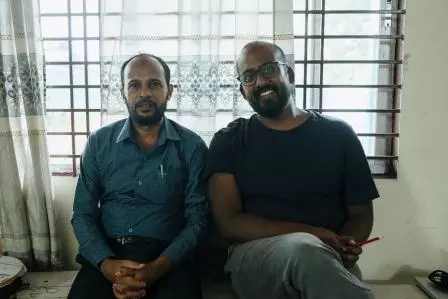
Zia Sahat Hero, a Rohingya photojournalist (right) and Victor Caringal, Doctors Without Borders Australia photographer (left)
The following photos are arranged in the photographers’ preferred sequence.

A lone Rohingya man walks through the Kutapalong refugee camps. Bangladesh, 2025. © Victor Caringal
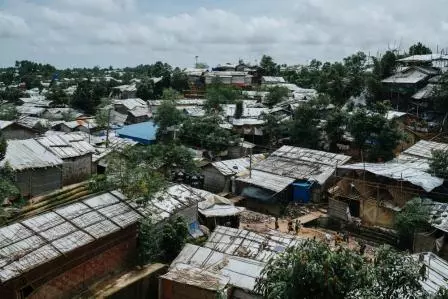
In 2017, large forest areas were cleared to make way for shelters as more than 700,000 Rohingya fled violence in Myanmar and sought refuge in neighbouring Bangladesh. Some of the foliage has now regrown, providing much needed shade in the heat of the densely populated camps, but it also marks eight years of separation from their homeland that the Rohingya have faced.
We picked this image to show the densely packed setting of the camp shelters. The camps are overwhelmingly large, but at the same time, enclosed, restricted and overbearing. Zia notes that the beautiful greenery and regrowth is in stark contrast to the poor conditions of the temporary shelters that Rohingya live in.

A Rohingya woman walks into Doctors Without Borders' Balukhali clinic in Kutapalong refugee camp. Bangladesh, 2025. © Victor Caringal
This image reminded us of conversations we had about Rohingya unable to leave their mark or legacy in the world. The woman walks through the camp with traceless steps, battered by rain. The rain is suspended, like how Rohingya feel about their situation, like their lives are on pause.

A man repairs his shelter in the Kutapalong camps. Bangladesh, 2025. © Victor Caringal
We spotted this man repairing his shelter while walking through the narrow streets of the camps. He appeared impressively strong, carrying out repairs to the temporary bamboo shelter that protects his family during monsoonal storms. It’s a type of strength and resilience that’s easy to photograph, but what this man represented for me, is how I see all Rohingya – a people who have to be strong to survive, to carry more emotional weight than anyone should ever have to carry.

Shelter on an unstable slope. Bangladesh, 2025. © Zia Sahat Hero
Escalated violence in Myanmar’s Rakhine state has led to the recent arrival of more than 700,000 Rohingya seeking safety in Bangladesh. With little remaining space in the densely populated camps, these Rohingya built their shelter on an area of land prone to landslides. Their new home is far smaller than the one they left behind.

A Rohingya girl studies in her shelter. Bangladesh, 2025. © Zia Sahat Hero
Recent aid cuts have left learning centres closed and contracts terminated for 1.179 local teachers within the camps. Education is one of the few opportunities Rohingya youth have to improve their situation.
We chose this image because it showed the fragility and hope of young Rohingya and how decisions made today will have a ripple effect on future generations.
Children’s play and imagination. Bangladesh, 2025. © Zia Sahat Hero
Children’s play and imagination create moments of relief from daily challenges in the camps. Their vision of a better future are not only expressions of hope but also a way to manage and process the difficult realities around them.
While we walked through the camps, we saw that children were everywhere – laughing, playing, and sometimes being scolded. They brought life to the camps and pockets of joy. Zia noted that the reason there were so many kids was because of the school closures from aid cuts.

A child overlooks the camps from an eroded hill top. Bangladesh, 2025. © Zia Sahat Hero
We selected this image to share the threat of landslides that occurs from monsoonal rain and flooding, and the eroded soil in the camps. Originally there were shelters built here, but these were lost in a landslide. The area now remains precarious and unoccupied, despite the child standing and smiling from the top of the hill.

Rayhana, Rohingya food stall owner, in her shelter. Bangladesh, 2025. © Victor Caringal
I was impressed to see how much food Rayhana was able to prepare within the tight quarters of a shelter kitchen space. Rayhana opened a small food stall in the camps to financially support her family. While there is a food ration in place, it’s currently at US$10 a month per person, which is far below what’s needed to survive in the camps, and the reduction of aid means lower amounts in the future.

A young child seen through the tarpaulin. Bangladesh, 2025. © Zia Sahat Hero
We picked this pairing of images as they visually speak to a feeling of enclosure, a sentiment that many Rohingya in the camps talk about while living behind wired fences of the camps.

A chicken in a makeshift coup in front of a makeshift shelter. Bangladesh, 2025. © Victor Caringal
Farming was an integral part of Rohingya life during Zia’s childhood. In the dense camps where people have no permanent
home, land or space, it is rare for people to raise livestock or grow enough vegetables to make a living or survive from.

A daily worker prepares bamboo materials for building and repairing shelters. Bangladesh, 2025. © Zia Sahat Hero
Zia explained that bamboo was a traditional building material in Rohingya culture. In this picture, the bamboo looks fresh and green, but the quality of this bamboo is lower than what Rohingya would use for their homes and structures in Arakan.

A bridge crossing separates camp districts in Kutapalong refugee camp. Bangladesh, 2025. © Victor Caringal
We watched as people crossed the bamboo bridge: two girls taking careful steps, two boys racing to the top, backflipping into the water. Zia had taken photos of this crossing over the eight years he’d been in the camps. A wider bridge was once in place, but it eroded and was swept away over multiple flood seasons. While it looks precarious, the new bridge provides an important access route between the neighbouring camps.

A man is transported to a health facility. Bangladesh, 2025. © Zia Sahat Hero
NGO workers and foreign visitors typically travel to the camps via arterial roads. But deep inside the camps, the throughways become much tighter, and Zia explained that many parts are only accessible on foot. When a medical need arises, people need to be carried to the nearest hospital, a difficult journey which can take hours away in monsoonal conditions.