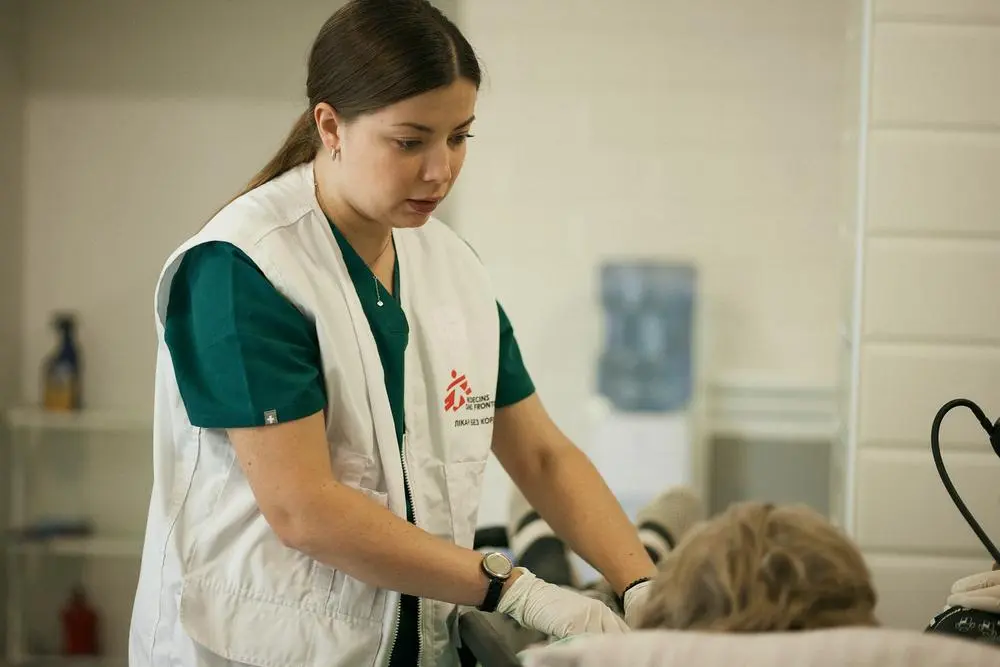
A Doctors Without Borders emergency doctor examines a 67-year-old patient who was brought to the emergency room by ambulace with complaints of loss of consciousness and severe pain. Ukraine, 2025. © Mariia Nahorna
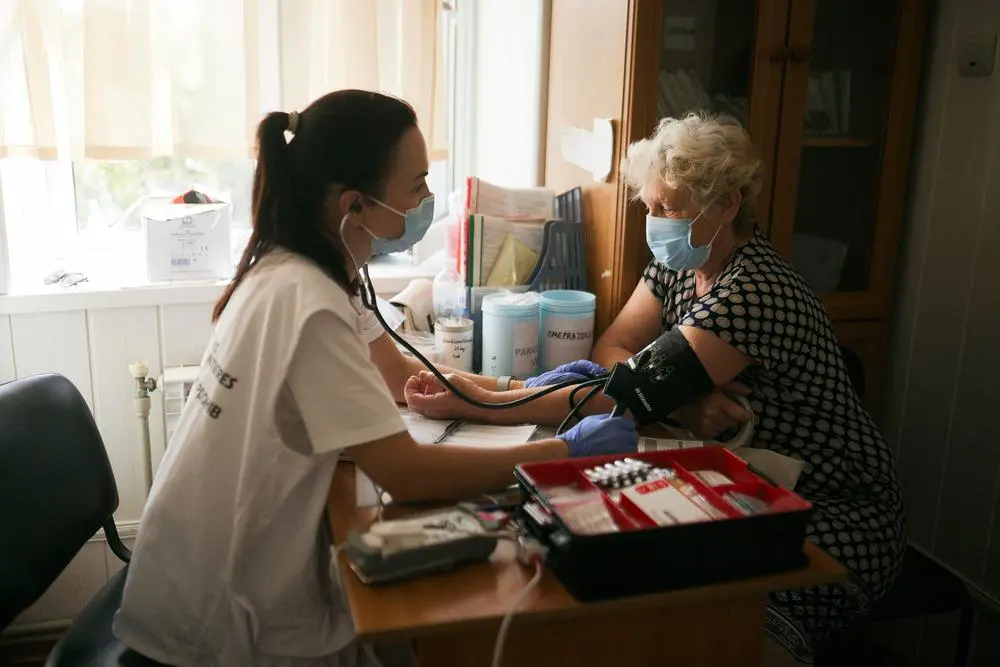
A patient attends a medical consultation during a Doctors Without Borders mobile clinic in Chornomorka, Mykolaiv region. Doctors Without Borders mobile clinics come to Chornomorka two times a month. More than 2,000 people live here, including internally displaced persons. Ukraine, 2025. © Mariia Nahorna
Like her, more than 3,200 patients seen for consultation by Doctors Without Borders in supported hospitals near the frontline have been directly referred to specialist hospital departments since the beginning of the year for stabilisation of their chronic disease. This represents over 75% of all patients seen by Doctors Without Borders at triage stage. The most common diagnoses are hypertension, diabetes, and ischaemic heart disease.
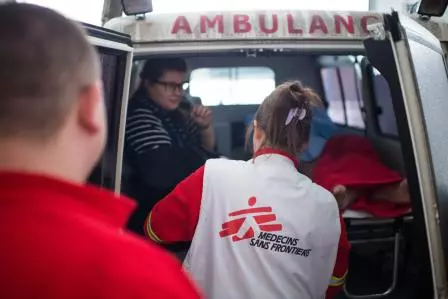
Mobile clinic teams working in shelters for displaced people and remote communities near the frontline report the same trend. In some cases, patients arrive in such severe conditions that ambulances must be called for urgent care.
“People are living under constant stress, exposed to daily attacks, power cuts, and prolonged uncertainty,” said Robin Meldrum, Doctors Without Borders Country Director in Ukraine. “This makes it difficult for them to recognise when a condition is serious. What should be manageable chronic conditions are becoming life-threatening.”
Among patients seen by Doctors Without Borders, many are elderly people presenting complications from disruption of chronic ambulatory care for medical conditions such as hypertension, diabetes, and asthma. Such complications – some of them life-threatening – could have been prevented with continuous care. In Kherson city, for instance, the average age of patients admitted to the intensive care unit we support is 63.
“By the time they reach a doctor, they are often already in critical condition — and sometimes too late,” said Meldrum.
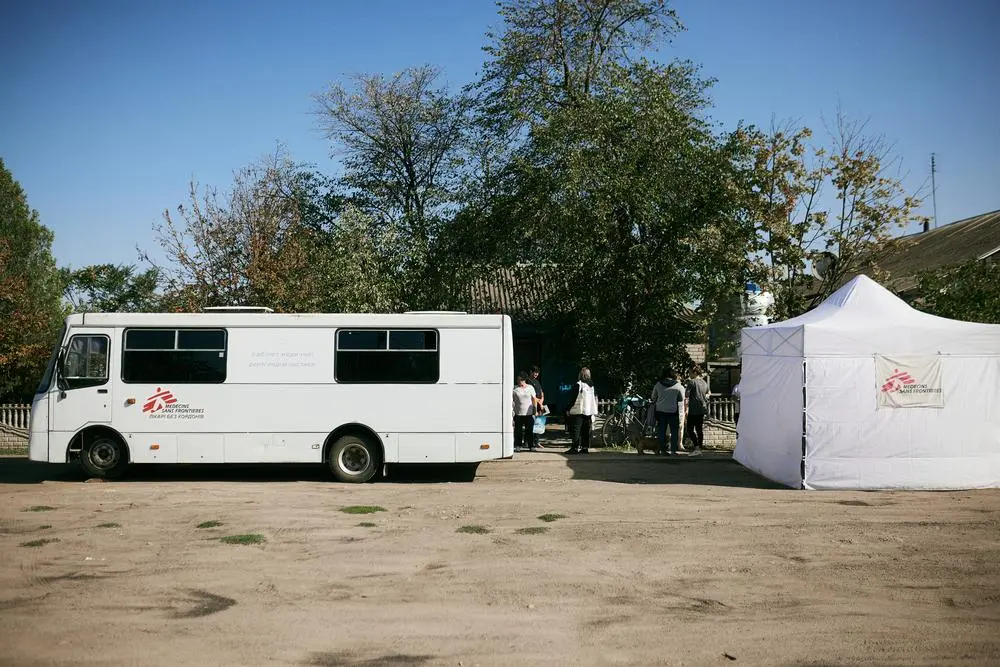
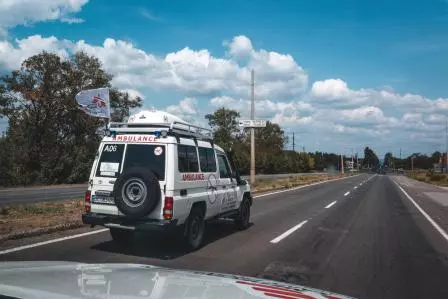
A Doctors Without Borders vehicle and tent posted in front of houses in a frontline community neighbourhood. These facilities are part of Doctors Without Borders' targeted tuberculosis (TB) screenings in the Mykolaiv and Kherson regions, where destroyed hospitals limit the communities' ability to undergo TB screening. Ukraine, 2025. © Mariia Nahorna
Bringing care closer
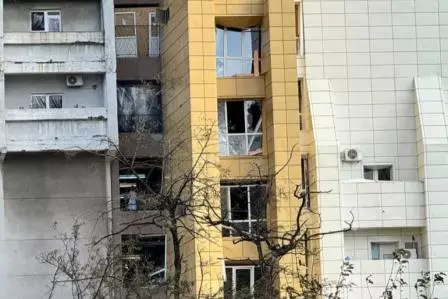
Access to healthcare remains a major challenge. Since the start of the full-scale invasion launched by Russian forces in February 2022, many local clinics have been damaged or destroyed, medical staff have left, and pharmacies are often closed. Reaching a doctor can require travelling long distances — sometimes 20, 30, or even up to 100 kilometres — along damaged roads and under the constant threat of drone strikes. Public transport has mostly collapsed.
Disruptions to healthcare are also affecting patients with tuberculosis and other infectious diseases. Many must travel long distances to continue treatment, while reduced access to diagnostics means cases may go undetected — masking the true scale of needs.
To address these gaps, Doctors Without Borders supports hospitals near the frontline and runs mobile clinics in Donetsk, Dnipropetrovsk, Kherson, Mykolaiv and Zaporizhzhia regions.
Humanitarian workers are also operating under constant threat; we have had to suspend activities in dozens of locations near the frontline because of missile and drone attacks.Katsa Brenneman,Health Promotion Manager
“We try to reach settlements where access to medical care is most limited,” said Katsa Brenneman, Doctors Without Borders Health Promotion Manager in Ukraine. “However, due to insecurity — including attacks on civilian infrastructure, railway stations, and passenger buses — people are afraid to leave their homes. Humanitarian workers are also operating under constant threat; we have had to suspend activities in dozens of locations near the frontline because of missile and drone attacks.”
Doctors Without Borders teams are trying their best to maintain some level of primary healthcare in areas that are too dangerous to access physically by conducting remote consultations. In these cases, a volunteer in the community is trained by Doctors Without Borders to take vital signs and assist with patient interaction, while consultations are carried out via video call with a Doctors Without Borders doctor.
As the war continues, ensuring access to basic healthcare is not only about treating emergencies but preventing them. Without timely care, manageable chronic diseases will continue to escalate into life-threatening conditions, silently worsening the health of those already living through extreme hardship.