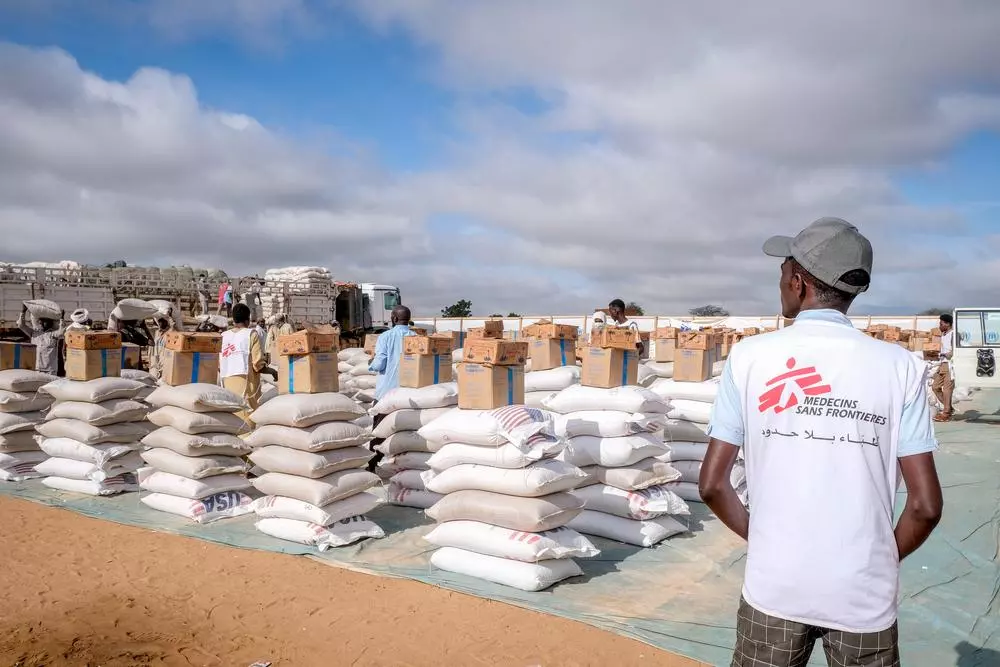
Doctors Without Borders staff participate in a soap distribution to prevent and control cholera in Adré, eastern Chad. 6,528 kits containing 75 bars of soap were distributed. Each person received three bars of soap. Chad, 2025 © Léa Gillabert/MSF
Since July 2025, a cholera epidemic has been ravaging eastern Chad, revealing the challenges associated with a fragile water supply and sanitation systems. As at 26 September, more than 2,475 cases and 141 deaths had been recorded.[1] In overcrowded Sudanese refugee camps and impoverished host communities, conditions are sadly ideal for the disease to spread. Transmitted through ingested water or food contaminated with bacteria present in the faeces of infected people, cholera spreads rapidly. It causes acute diarrhoea that can kill through dehydration in just a few hours – unless urgent treatment is administered.
To prevent people from becoming sick and to limit the epidemic overall, Doctors Without Borders has implemented preventive and curative activities in collaboration with the Ministry of Public Health and other non-governmental organisations.
What I take away from my experience is the need to communicate with the people around me. Because I was very ill, I would like to inform the community about the disease. If it weren't for the doctors, I would already be dead.Khamis Ahmat Ali, a patient
The importance of prompt treatment
"I didn't know what was making me sick, but as the diarrhoea wouldn't stop, my children took me to the health centre. I was given injections, but as my condition didn't improve, I was transferred to hospital. I can't find the words to describe how ill I was," says 65-year-old Khamis Ahmat Ali.
Khamis, who fled the war in Sudan with 50 members of his community under his care, was admitted to Adré Hospital in critical condition.
His experience illustrates one of the main challenges in the fight against cholera: the late arrival of patients. “Many arrive severely dehydrated and sometimes in shock,” explains Doctors Without Borders medical coordinator Guillaume Hondt.
People’s late arrival despite being sick can be explained by two main factors. One is a lack of knowledge about the disease and its symptoms, which delays patients seeking out appropriate facilities; the other is inadequate health infrastructure in the host communities and difficulty in reaching these facilities, which is exacerbated during the rainy season. Nearly half of all deaths among cholera patients occur outside of healthcare facilities, and the death rate is six times[2] higher than with the standard treatment.[3]
At the hospital and in Doctors Without Borders treatment centres and units, treatment is based primarily on rehydration, sometimes combined with antibiotics. “What I take away from my experience is the need to communicate with the people around me. Because I was very ill, I would like to inform the community about the disease. If it weren't for the doctors, I would already be dead,” explains Khamis.
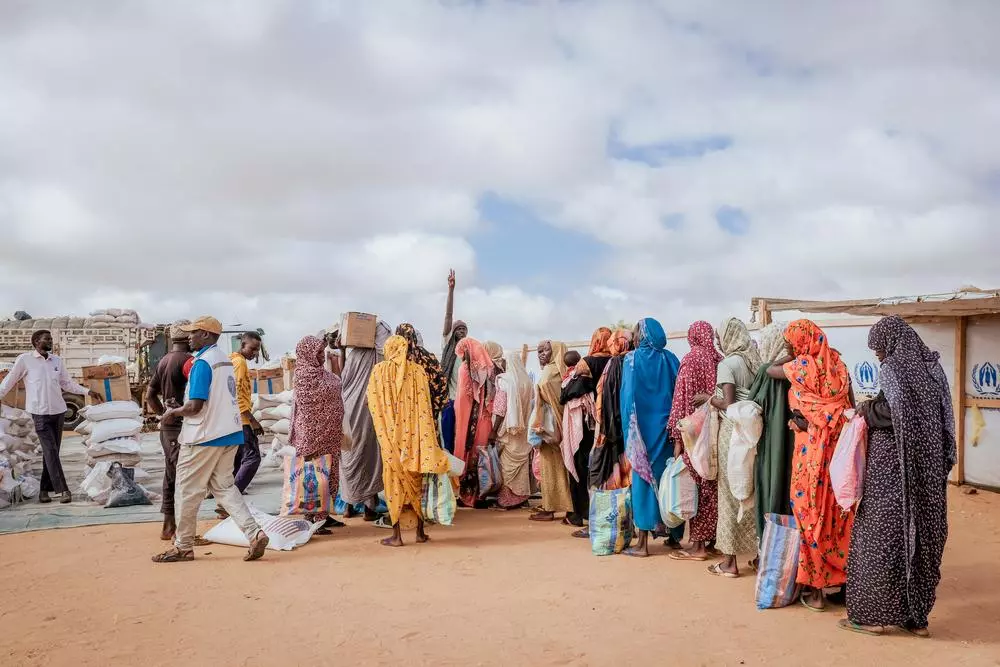
People wait at a soap and food distribution organized by Doctors Without Borders and WFP, through their partner Acted, in Adré, Eastern Chad. Chad, 2025 © Léa Gillabert/MSF
Prevention is better than cure
To curb cholera’s infectious spread, Doctors Without Borders teams have joined forces with the Ministry of Public Health (MSP) to set up or reinforced medical facilities, including specialised treatment centres, and to train community health workers to raise awareness among communities in camps, markets, surrounding villages and at the Chadian borders.
Alongside treatment, vaccination is crucial in preventing and controlling a cholera epidemic. That is why the Ministry of Public Health launched a vaccination campaign at the end of August. Targeting more than one million people in camps and the community, the campaign took place in seven health districts: Adré, Ameylouna, Chokoyane, Farchana and Hadjer-Hadid, Abdi and Goz Beida. Doctors Without Borders supported the Ministry of Public Health with vaccination and cold chain management in the camps and communities of Adré, Metché, Goz Beida and Aboutenge. Doctors Without Borders supported the Ministry of Public Health in vaccinating more than 630,000 people in refugee camps and host communities.
Vaccination also continues along various routes, particularly at the Sudanese border, to prevent the spread of the disease, which can be facilitated by people’s movements especially after the rainy season.
To improve hygiene conditions, Doctors Without Borders also organised the distribution of more than 550,000 bars of soap, reaching nearly 200,000 people in Adré. In the Iridimi camp in Wadi Fira, where an extension of the camp is taking in new arrivals from Sudan, Doctors Without Borders is working to improve access to water in the long term. In Hadjer Hadid, a district particularly affected with 704 cases and 51 deaths, Doctors Without Borders rehabilitated the town's water network, providing access to 75,000 litres of water to the townspeople who previously had no access to water.
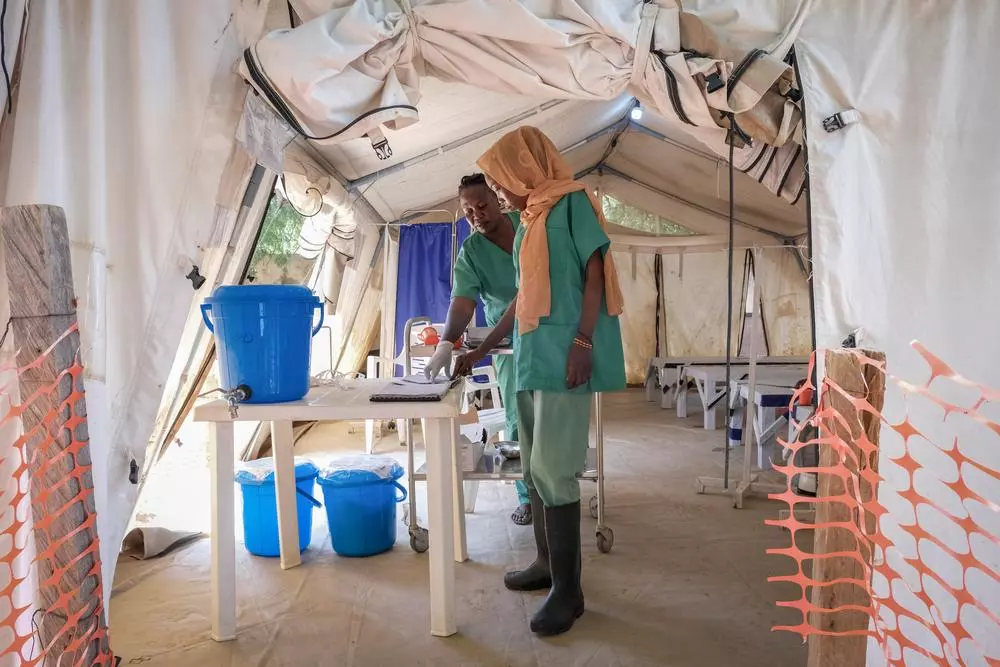
The Doctors Without Borders cholera treatment unit in Adré, eastern Chad. Chad, 2025 © Léa Gillabert/MSF
Crisis in the East: An environment conducive to the spread
Although the situation is stable in Adré, the current epidemic risks growing even further particularly in eastern Chad, where the disease is already endemic. Since April 2023, more than 877,000 Sudanese refugees have crossed the border into Chad to flee the civil war, with the majority finding refuge in the province of Ouaddaï.[4] Outbreaks are all the more likely due to people being displaced and precarious living conditions inside and outside the camps.
Access to water is extremely limited and mostly well below the threshold of 15 litres of water per person per day recommended in emergency situations. Sanitation facilities are also inadequate. “Currently, in Adré, there is one latrine for every 160 people, whereas the standard in emergency situations is one latrine for every 50 people,” explains Jude Progo, Doctors Without Borders water and sanitation manager for cholera. This lack of latrines forces people to defecate in the open air, increasing the risk of cholera transmission, particularly during the rainy season.
The epidemic, which had previously been concentrated in the province of Ouaddaï, has now spread to communities in Guéra and Sila, where Doctors Without Borders has sent a new response team. While preventive measures are essential as the affected area grows, they must also go hand in hand with access to safe drinking water and adequate sanitation infrastructure. A strong and coordinated commitment from national and international actors through the funding of water and sanitation activities is crucial to achieving this.
Doctors Without Borders' cholera response in Chad
Doctors Without Borders is involved in preventing and treating cholera infection in communities in Adré, Aboutenge, Metché, Irdimi, Tulum, Tiné and Allacha, Hadjer Hadid, Goz Beida and Abdi through vaccination, cold chain management, active case finding, epidemiological surveillance, health promotion, soap distribution, water supply and sanitation, and the establishment of several cholera treatment units and centres.
[1] Ministry of Public Health of Chad. (2025, September 23). Situation report on the cholera epidemic in Chad.
[2] Ministry of Public Health of Chad. (2025, September 23). Situation report on the cholera epidemic in Chad.
[3] https://www.who.int/news-room/fact-sheets/detail/cholera
[4] UNHCR Chad. (2025, September 14). Influx of refugees from Sudan: Biometric Individual Registration Statistics (as of September 14, 2025). Dashboard.
Will you support our work?
Help us provide lifesaving medical care by making a donation today.